
Original German Case Study Content for International Software & Technology Companies
German Case Study Writing · Technical B2B Content · Software & SaaS · Enterprise Technology
Native German Expertise
Independent Since 2002
Direct Project-Based Collaboration
Specialized in IT & Software
Two Software Challenges, Developed as Original German Case Studies
The two examples show how complex software and implementation topics from international B2B environments can be developed into German case studies for the German market.
The editorial task is to identify the central challenge, select the information that explains it and structure the content with the terminology, depth and narrative logic appropriate to the subject.
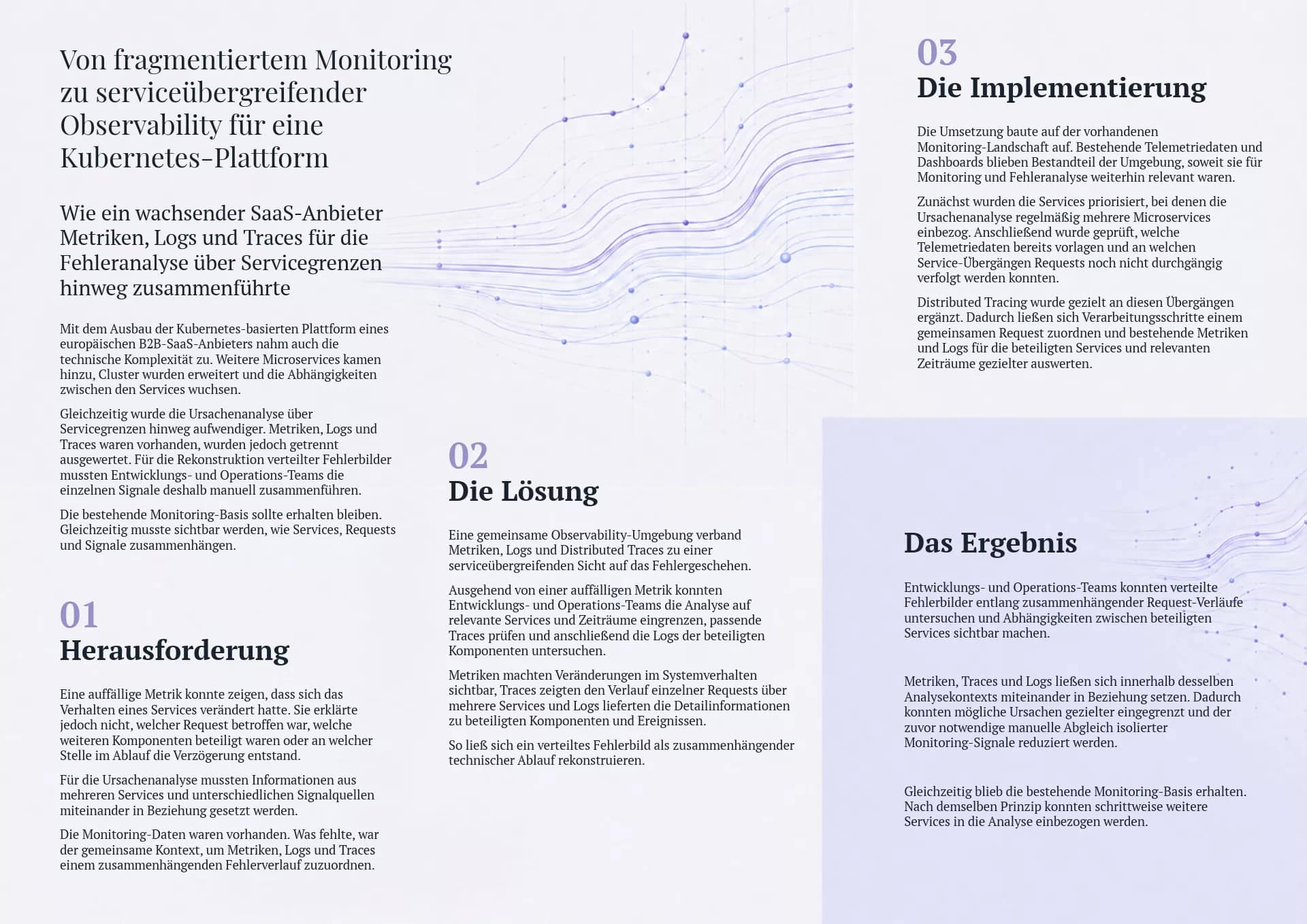
One example focuses on a Kubernetes-based SaaS platform where metrics, logs and distributed traces are connected across multiple services to enable cross-service error analysis.
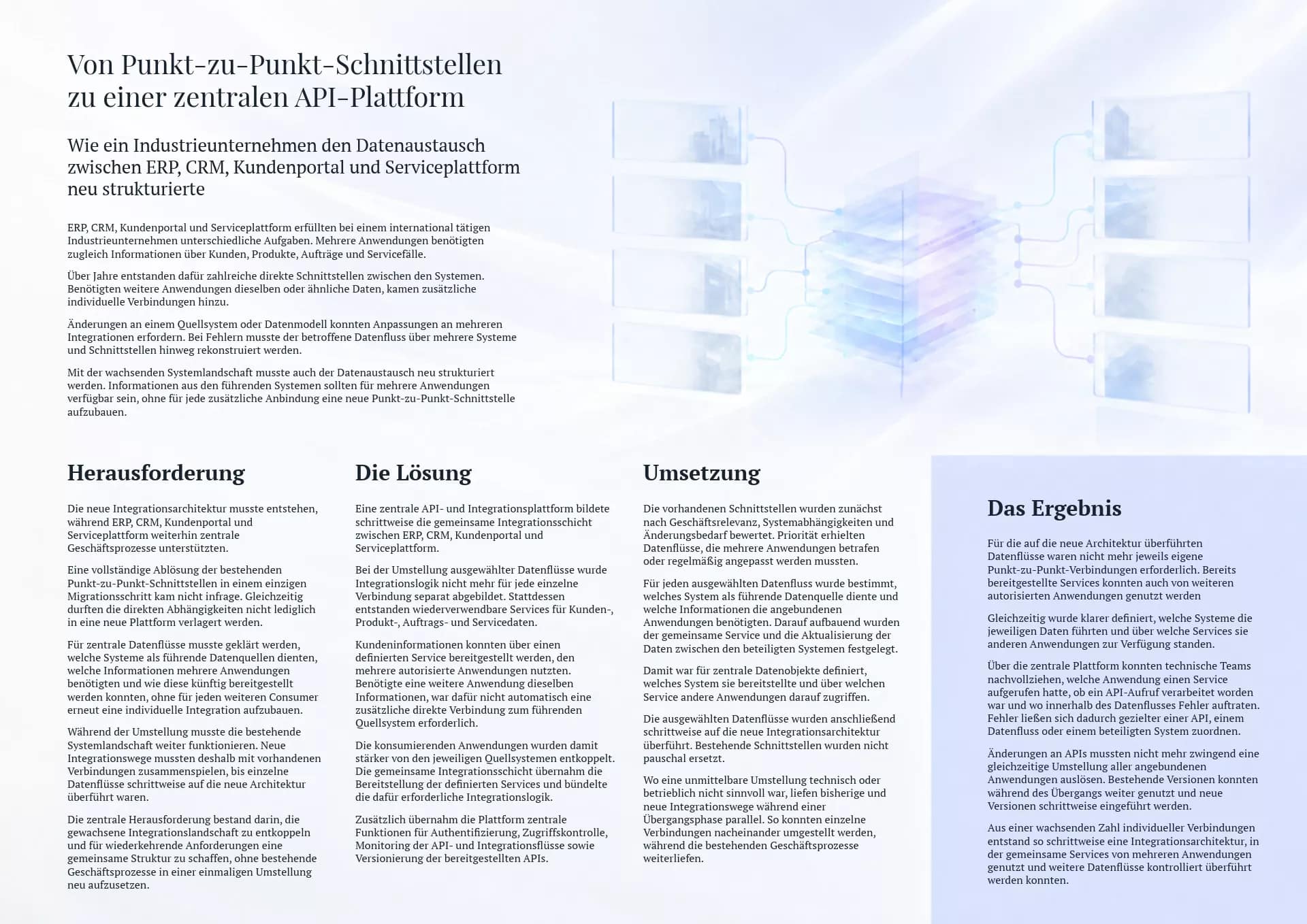
The other explores how an enterprise environment with ERP, CRM, a customer portal and a service platform can move from a growing network of point-to-point integrations towards a shared API and integration layer.
The two subjects call for different explanatory logic. The observability example makes distributed runtime behaviour understandable by connecting monitoring signals, requests and service dependencies. The integration example shows how systems, source-system responsibilities, reusable services and migration decisions shape an architectural transition.
In both examples, terminology, explanation depth and narrative structure are shaped around the software context, connecting specialist detail with a clear account of the challenge, solution and practical relevance.
Developing Original German Case Studies from International Software Expertise
The two examples show how complex software and technology knowledge can be developed into German B2B case studies for international companies communicating in Germany.
The work begins with the software challenge, available product and project information and the communication objective.
Original
German Content
The case study narrative is developed directly in German around the software subject and the information the reader needs to understand the challenge, solution and implementation.
In the observability example, metrics, logs, distributed traces and service dependencies form the basis for explaining cross-service error analysis. In the integration example, ERP, CRM, customer portal and service platform establish the relationships behind the transition towards an API and integration layer.
The resulting content is German communication in its own right rather than a German reproduction of an existing English narrative.
Information
Priorities
Complex software projects contain more information than a case study can present with equal weight. The editorial task is to identify the details that explain the central challenge and support the main argument.
For observability, the decisive issue is the missing context between monitoring signals across services and requests. For enterprise integration, the focus lies on point-to-point dependencies, source-system responsibilities, reusable services and the controlled transition to a shared integration layer.
These priorities create a clear case study narrative in which carefully selected specialist detail supports the central argument.
Technical Depth
in German
Technical credibility depends on precise terminology and sufficient implementation detail, while the explanation itself follows the clarity, structure and rhythm of professional German B2B communication.
The observability example covers service prioritisation, telemetry and distributed tracing to show how cross-service analysis works. The integration example includes source-system responsibilities, reusable services, migration, parallel operation and API versioning to clarify the transition.
The content retains the specialist substance of the subject while presenting it in clear, natural German.
Business
Relevance
The outcome connects architecture and implementation with their practical consequences, showing how the technical changes affect the way systems are operated, monitored and developed further.
In the observability example, previously separate monitoring signals become part of one connected analysis context. In the integration example, reusable services reduce additional direct connections, responsibilities become clearer and integration flows become easier to monitor.
This connects the software change with its practical relevance for technical stakeholders and decision-makers.
Original German Case Studies with Technical Depth and Clear Narrative Logic
The two case studies show how different software subjects require different editorial priorities and explanatory structures while maintaining technical precision and clear German B2B communication.
Architecture, dependencies and implementation decisions are selected, weighted and structured according to the central software challenge and the information readers need to understand its practical significance.
The result is German software content that turns complex product and implementation knowledge into focused case study narratives for customers, technical evaluators and decision-makers in the German market.
Two Original German B2B Software Case Studies
The two selected works cover distinct software environments: cross-service observability across a Kubernetes-based SaaS platform and the transition from point-to-point integrations to a shared API and integration layer.
Both are presented in their original German form.
Turn Complex Software Expertise into Clear German B2B Case Studies
German B2B software case studies can be developed directly from technical project information, interviews, product documentation and existing source materials.
Briefly describe the software product, project context, available materials and intended use.
You will receive a personal response with a recommendation on scope, content structure and next steps.